
Why we are building a new way to hire

Why we are building a new way to hire

Promise Udenkwor
November 4, 2025
3 min read

Hiring is one of the most important aspects of building a company; it can set a team on a parabolic trajectory or quietly stall its growth. Teams approach their hiring strategy carefully, leading to hiring strategies that are diverse and dynamic.

Small teams often rely on familiar faces, former colleagues, or trusted connections. Larger teams turn to recruiters to manage volume. At the enterprise level, hiring might become a top-down process defined by specific requirements and qualifications. The information needed for these different approaches naturally differs: small teams may prioritize basic details like source, referral, and projects; growing teams begin to focus on years of experience and previous employers; mid-sized companies and enterprises emphasize qualifications, structured evaluations, and prior experience.

Unfortunately, most of today’s leading hiring tools, many built decades ago, were not designed for this level of flexibility. Instead, they follow a lowest-common-denominator model with rigid hiring roles and outdated processes. But hiring is far more nuanced than that. The right hiring process is the one that works for the team, and the right tool should reflect that dynamism, enabling, strengthening, and simplifying each team’s unique way of hiring.

We believe this ethos cannot be retrofitted into existing systems. Attempts to do so have only created more complexity, poorer candidate experiences, and fragmented collaboration, leaving teams to spend weeks or months learning a tool and reshaping their hiring strategy around it instead of the other way around. This has led to hiring being regarded as one of the most frustrating and difficult parts of building a company.

This is why we are building Ornelle, an enjoyable way to build great teams with flexibility, personalization and intelligence at its heart.
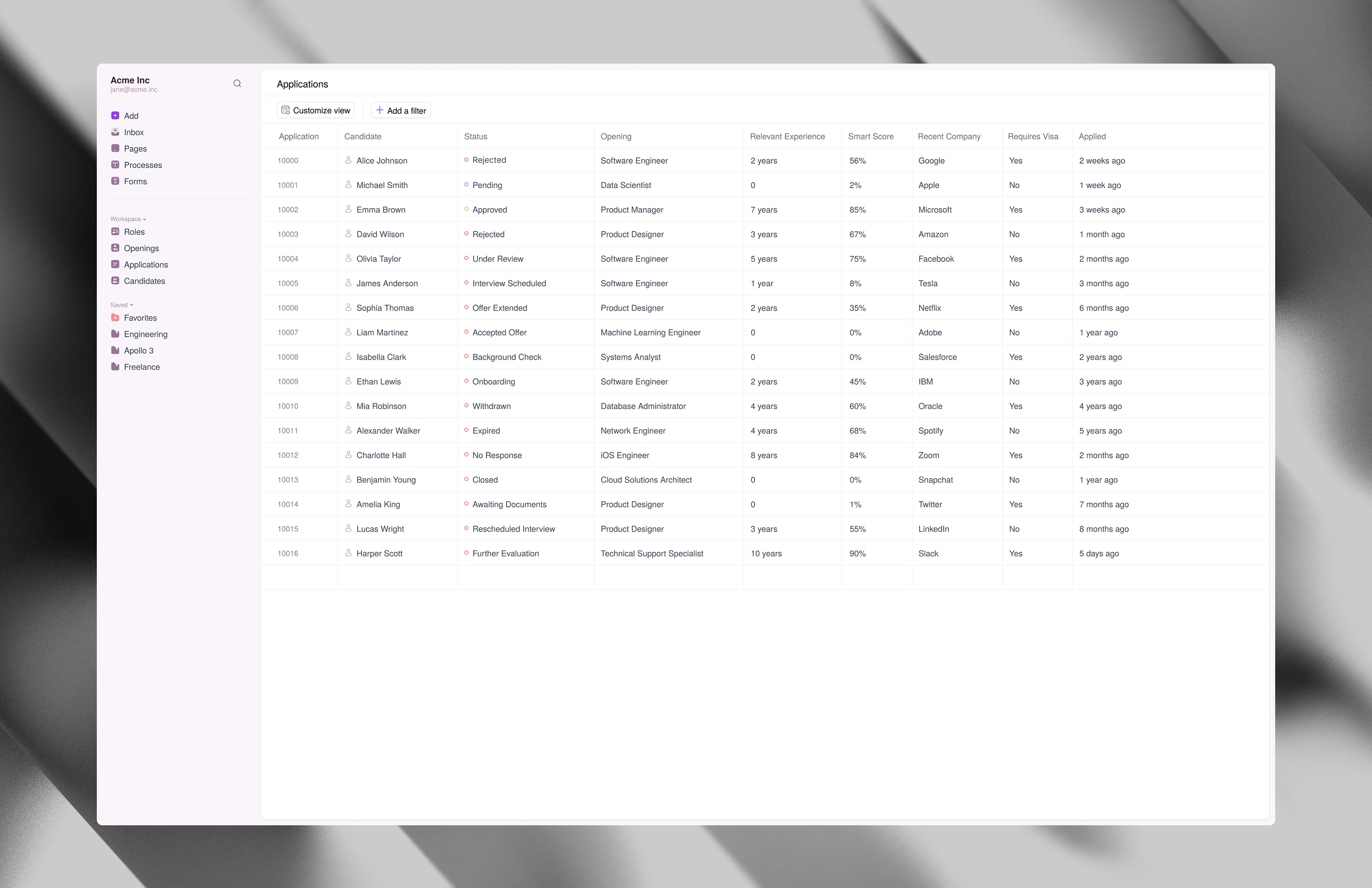
Ornelle hiring workflow

Other areas of building a company, like sales and project management, have powerful, modern tools that have evolved to help teams move faster and simplify work. Hiring deserves the same level of craftsmanship and thought. We’re building it.

Our approach

Any hiring strategy involves all or some of the following: content creation, data collection, discovery, assessment, engagement, collaboration, analytics, and sourcing or networking. Our goal is to bring all of that into one unified system that is fast, flexible, and intelligent.

Flexibility

We’re rethinking how teams discover and collaborate on talent.

We are bringing the three forms of talent discovery: inbound applications, sourcing from external networks like LinkedIn, and network referrals, into one intuitive interface for a seamless, faster, and more collaborative hiring experience.

Every company has its own structure and process for hiring. So flexibility is at the core of the user experience we are creating. We’ve built extensibility as an integral part of the platform. For example, teams can define internal roles and attributes such as “Hiring Manager”, “Recruiter”, “Approver”, “Department”, “Location”, “Contract Type”, and apply them to roles or openings.

Access and collaboration follow the same philosophy, flexibility without compromise. Instead of rigid, built-in roles that rarely fit unique hiring processes, permission groups can be created from granular permissions or skipped entirely. Teams can create as many permission groups as they need, each reflecting how they actually work, not how the software expects them to.

Intelligence

We are building intelligence into every part of the hiring experience to make finding, evaluating, and engaging talent faster and more effective.

At the center is the assistant, a conversational interface to the entire platform. It understands context, extracts what matters, performs actions, and guides decisions, turning the complexity of hiring into simple, intuitive interactions.

With natural language search that understands intent and context, we hope to make discovery feel natural. Whether it’s “Designers in Europe who have worked on B2B SaaS and know Figma” or “Engineers referred by team members with backend experience”, candidate searches spans both an organization’s private candidate pool and millions of external profiles, combining depth with scale.

Hiring processes often follow clear, repeatable sequence of steps such as screening, interviews, assessments, and approvals. We are bringing all of these together into flexible, visual workflows that teams can design and adapt freely, making collaboration, assessment, and engagement simpler and less manual. Workflows automate the repetitive and time-consuming parts of hiring processes like application status updates, status communication, review requests and interview scheduling, freeing the team up to focus on the more important parts of hiring: building meaningful connections with great talent.

User Experience

Speed is our design principle. Together with clarity, focus, and personalization, they define the user experience we are creating. Every part of the interface is built to minimize friction and keep teams in flow.

Applications, candidates, openings, and roles all live in powerful data grids that support inline editing, sorting, bulk actions, complete customization and more. Custom attributes appear directly in the grids and can be created for any entity, giving every team the freedom to display and manage what matters most.

Advanced filtering makes it easy to find exactly what’s needed, supporting any attribute including custom and relational ones. Filters and layouts can be saved as Views, which stay accessible from the sidebar for instant navigation. Favorite candidates, filtered sets of applications, or key workflow stages can all be saved for quick access. At a glance, teams can see information that’s important to them and act immediately.

No other hiring platform matches this level of performance and flexibility, and we are just getting started.